This illusion is based on a billboard showing a bathtub shot at an angle. As we walk from one end of the picture to the other, the bathtub seems to stretch and shrink. Why? Each change in location results in a different retinal image. When processed in the usual way, each of these images results in a different 3D percept. Walking past the real bathtub will also produce a series of retinal images, different from those produced by the picture. All of these images will elicit a single, common 3D interpretation, and thus shape constancy.
The steerable spiral
We show an array of moving spots. Each spot travels in a spiral counterclockwise towards the center of the screen, but contains a grating that moves opposite to its direction of travel. When each spot is by itself its direction of travel is clear. But when we arrange the spots so they are closer together on the screen, they appear to move in different directions — either inward or outward, and either clockwise or counterclockwise, depending on how we arrange them. The proximity of each spot to its neighbors “steers” the perceived direction of motion.
The monkey-business illusion
You might have heard about my earlier demonstration in which people fail to notice a person in a gorilla suit when they are busy counting how many times a group of people pass a basketball (see www.theinvisiblegorilla.com). People can only experience the gorilla effect once-after they know to look for a gorilla, it is no longer unexpected. But what would happen if we tried showing you another video just like it? If you know that something unexpected might happen, and you actively look for unexpected events, does that make you more likely to notice them? Try it for yourself.
Daniel Simons’s presentation of “The Monkey Business Illusion” at the Best Illusion of the Year contest in 2010. He gave the presentation while wearing a gorilla suit.
The fat face thin (fft) illusion
It is well-known that faces are more difficult to recognise when they’re upside-down and that sometimes we misperceived the facial expressions of upside-down faces as is shown in ‘The Margaret Thatcher illusion’.
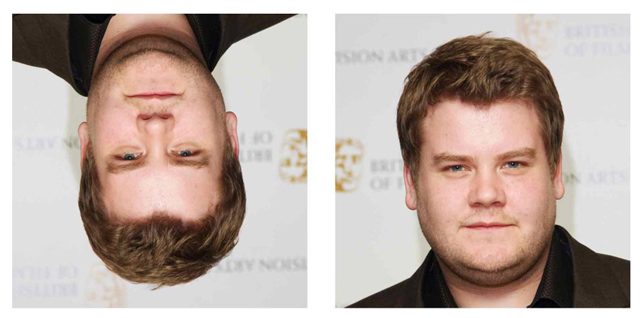
Now I give you ‘The Fat Face Thin illusion’. Compare the upside-down face on the left of the lower figure with the upright face on the right. The upside-down version looks much thinner, – altogether a longer shaped face than the upright version. Of course the pictures are identical. This illusion illustrates the internal features of the face, (eyes, nose, mouth) can distort our perception of face shape.
Attention-biased after-image rivalry
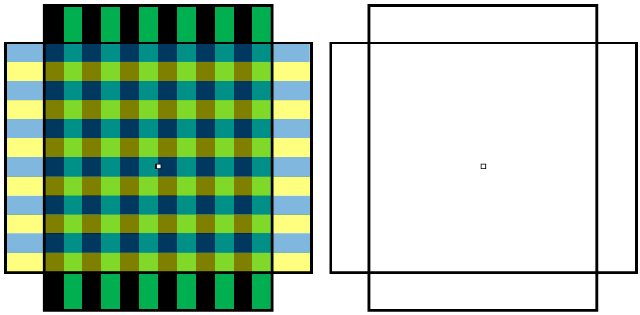
Fixate the colored image by looking at the fixation spot for about 60 seconds. Now shift your eyes to the fixation spot surrounded by rectangular outlines. If you attend to the vertical outline rectangle you will see the afterimage corresponding to it, and if you attend to the horizontal outline rectangle you will see the different afterimage corresponding to it. You can shift which afterimage you experience by attending to one rectangle and then the other.
Illusory gloss
The movie shows a Brownian surface (which has a fractal structure, but this does not seem to be important for the illusion). The appearance seems to change between matte and glossy, as the ruler illustrates. However, the surface is continuously rendered with matte (Lambertian) reflectance. What is happening is that the height of the surface is stretched in the viewing direction. The illumination direction is transformed together with the stretching to keep the cast shadows constant. This combined transformation of the light and surface height results in an illusory gloss. We initially though that the effect could be attributed to a luminance histogram skew transformation, but this seems not the case. A simple version of the current explanation is that stretching a surface together with the light direction (the so-called Bas-Relief transformation), induces illusory highlights due to darkening at points where the surface normal points away from the optical axis.
The break of the curveball
In baseball, a curveball creates a physical effect and a perceptual puzzle. The physical effect (the curve) arises because the ball’s rotation leads to a deflection in the ball’s path. The perceptual puzzle arises because the deflection is actually gradual but is often perceived as an abrupt change in direction (the break). Our illusions suggest that the perceived “break” may be caused by the transition from the central visual system to the peripheral visual system. Like a curveball, the spinning disks in the illusions appear to abruptly change direction when an observer switches from foveal to peripheral viewing.
Color dove illusion
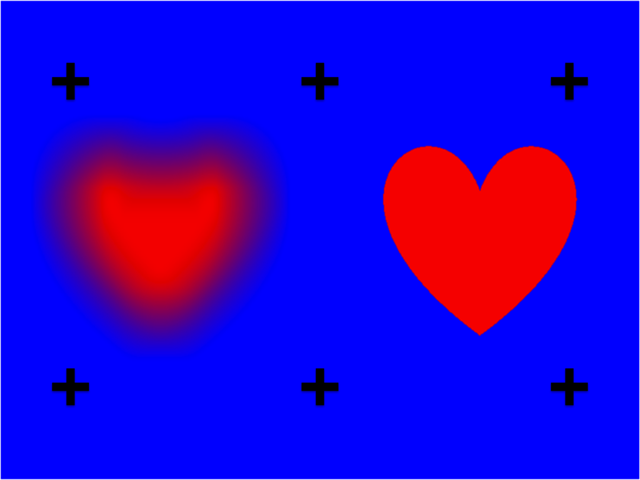
Fix your gaze on the central black point on the bird, as well as while the sky flashes. When the bird starts to fly, follow it, and keep staring at the black fixation point. You’ll start to notice, that the “empty bird” is filled-in with a color similar to the previous background’s color. The colored image produces illusory colors, an afterimage on “empty” shape, which induces an effect opposite to the well known “afterimage” effect. The common “afterimage” effect yields perceived complementary color, whereas the current effect shows an appearance of a color similar to that of the background, where originally, no physical color was present in the empty shape.
The illusion of sex
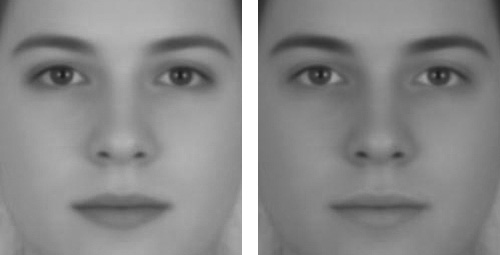
In the Illusion of Sex, two faces are perceived as male and female. However, both faces are actually versions of the same androgynous face. One face was created by increasing the contrast of the androgynous face, while the other face was created by decreasing the contrast. The face with more contrast is perceived as female, while the face with less contrast is perceived as male. The Illusion of Sex demonstrates that contrast is an important cue for perceiving the sex of a face, with greater contrast appearing feminine, and lesser contrast appearing masculine.
Russell, R. (2009) A sex difference in facial pigmentation and its exaggeration by cosmetics. Perception, (38)1211-1219.