The Loch Ness Aftereffect

2011 Third prize
Mark Wexler
Université Paris V, France

Fixate the red point you will see in the center while paying attention to the rotating ring of gray lines

Most observers perceive that the ring of lines rotates slowly, with brief jumps of much faster rotation in the opposite direction. The very fast jumps are illusory. The illusion usually gets stronger after one or two jumps, and seems to be enhanced by paying close attention to the lines in the ring.

The most famous illusion of movement is the motion aftereffect: look at uniform motion for a while, and things will seem to move the other way. It was discovered a long time ago by staring at a waterfall in Scotland, and, though important, is a bit boring: the illusory motion is slower than the real movement that induces it. As it turns out, the Scottish waterfall actually feeds… Loch Ness, and that just under the placid surface of the motion aftereffect lurks a true monster, capable of producing illusory motion a hundred times faster than the inducing movement.

Facebooktwittermail
adminThe Loch Ness Aftereffect

The more-or-less morphing face illusion

Rob van Lier & Arno Koning
Donders Institute, Netherlands

The illusion comprises a morphing sequence between two faces. The observer has to fixate a dot superimposed on the morph. When the dot is moving, morphing can hardly be seen. However, when the dot suddenly stops, the morphing appears surprisingly strong. Subtle differences in, e.g., the shape of the eyes, the color of the skin, and even gender characteristics are “blown-up” perceptually. Apparently, such differences between faces are easily overlooked when following a moving-dot, but are highly salient when our eyes rest at a single point on the morphing faces.

Facebooktwittermail
adminThe more-or-less morphing face illusion

Impossible Illusory Triangle

Christopher Tyler
Smith-Kettlewell Institute, USA

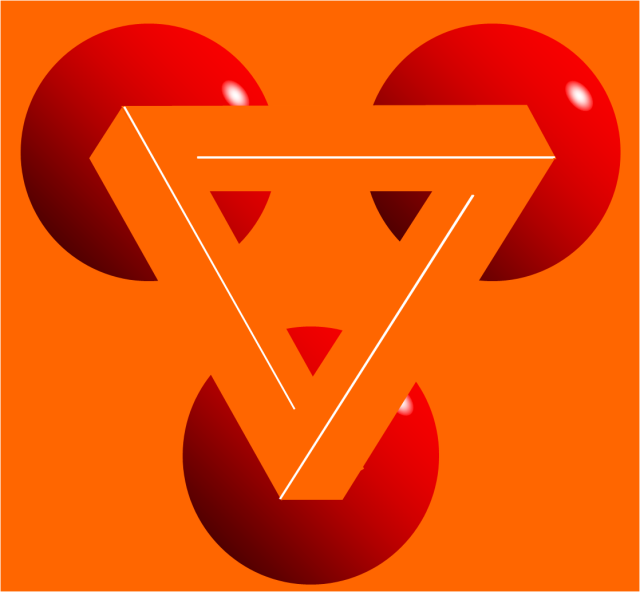
Begin with a three-line figure resembling three chopsticks arranged in a triangle. A wave of a magic wand behind it reveals the structure of a solid triangular object existing only in the way that it dynamically occludes the waving wand. Each part of the object makes sense on its own, but they cannot integrate into a single coherent object because each corner wants to be in front of the other two – a profound 3D spatial intransitivity characteristic of the classic Penrose impossible triangle. The perceived 3D figure generated in this way is simultaneously both illusory and impossible.

Download presentation

Facebooktwittermail
adminImpossible Illusory Triangle

Attention-induced motion displacement

Peter Tse, Patrick Cavanagh, David Whitney & Stuart Anstis
Dartmouth College, USA, UC San Diego, USA, Université Paris Descartes, France

Fixate the blue dot.
When you attend to the whole white layer”s motion, the red dots appear to be slanted to the right.
When you attend to the whole black layer”s motion, the red dots appear to be slanted to the left.

When you don”t attend to either layer, the dots are aligned vertically, which they in fact are in every case.

Facebooktwittermail
adminAttention-induced motion displacement

The Exchange of Features, Textures and Faces

Arthur Shapiro & Gideon Caplovitz
American University, USA, University of Reno, USA
This movie requires Flash Player 9

The binding problem is a fundamental issue in neuroscience. The term refers to the fact that the brain processes color, motion, and other visual features separately and in parallel, yet our perception is of a unified world, populated by coherent objects. Here we investigate the binding problem with illusions that show—rather dramatically—that features can bind and rebind to moving objects. We show that this effect depends on the color of the background and on whether observers view the illusions centrally or peripherally.

Facebooktwittermail
adminThe Exchange of Features, Textures and Faces

Fishbone Tactile Illusion

Nakatani Masashi
Keio University, Japan

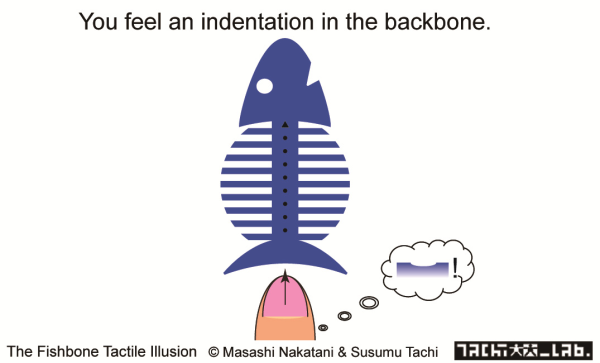
The “Fishbone Tactile Illusion” occurs with a stimulus with the centerline (“fish spine” sandwiched by the ridges (“tiny bones”). You would feel indentation in the centerline, when stroking it with a fingertip, even though it is as flat as the ridges. This illusion occurs because both surface form and texture information are transmitted by the same tactile afferent nerves. Due to the cross talk between those two streams of information, the texture in the ridges can bias the form perception of the centerline. The sample is on my business card, so please come get one and enjoy the illusion!

Facebooktwittermail
adminFishbone Tactile Illusion

Illusions from rotating rings

Stuart Anstis & Patrick Cavanagh
UC San Diego, USA, Université Paris Descartes, France

A rotating figure 8 made of two overlapping rings is ambiguous. Small spots painted on the rings can resolve the ambiguity, forcing them to look like an 8 or like 2 rings. Even without any spots, if the brightness of the intersections where the rings overlap makes the rings look transparent, they slide. If not, they stick.

Facebooktwittermail
adminIllusions from rotating rings

Impossible motion: magnet-like slopes

2010 First prize
Kokichi Sugihara
Meiji Institute for Advanced Study of Mathematical Sciences, Japan

In this video, wooden balls roll up the slopes just as if they are pulled by a magnet. The behavior of the balls seems impossible, because it is against the gravity. The video is not a computer graphic, but a real scene. What is actually happening is that the orientations of the slopes are perceived oppositely, and hence the descending motion is misinterpreted as ascending motion. This illusion is remarkable in that it is generated by a three-dimensional solid object and physical motion, instead of a two-dimensional picture.

Facebooktwittermail
adminImpossible motion: magnet-like slopes

Counter-intuitive illusory contours

2010 Second prize
University of Sydney, Australia

In many natural scenes, portions of occluding surfaces and contours can be camouflaged by having an identical color as their background. It is now well known that the visual system will often generate illusory contours and surfaces in order to fill-in this missing information. It is widely believed that the visual system does this in order to provide the best overall “explanation” of the images that form in our eyes. In this illusion, four circular disks are simply translated back and fourth over a thin square outline. Although all of the image data is fully “explained” by the visible disks, the visual system generates a strong and clearly visible additional illusory contour inside the square outline. This illusion cannot be understood with any known mechanism or theory that has been proposed to explain the formation of illusory contours. This quicktime movie is best viewed by downloading it and playing it in “loop” mode.

Facebooktwittermail
adminCounter-intuitive illusory contours

Two sinusoids: 6 – 1 perceptions

2010 Third prize
2010 Third prize

Jan Kremlacek

Charles University in Prague, Czech Republic
This movie requires Flash Player 9

Multiplication of stationary and moving sinusoid builds a moving curve with five perceptible and one hardly traceable interpretation. After a short observation a jerky leftwards motion (1st percept) transforms to a rigid rotating double-helix (2nd) or a flexible weaving ribbon (3rd). Both structures derived from the motion are ambiguous and can be perceived as rotating or waving in one of two ways (4th and 5th). Displaying the curve as dots bouncing up and down without any change of their horizontal position creates 6th percept, which is difficult to follow. To explore all multistable perceptions use the movie cues.

Facebooktwittermail
adminTwo sinusoids: 6 – 1 perceptions