Rotating by Scaling

Attila Farkas and Alen Hajnal
University of Southern Mississippi, USA
This movie requires Flash Player 9

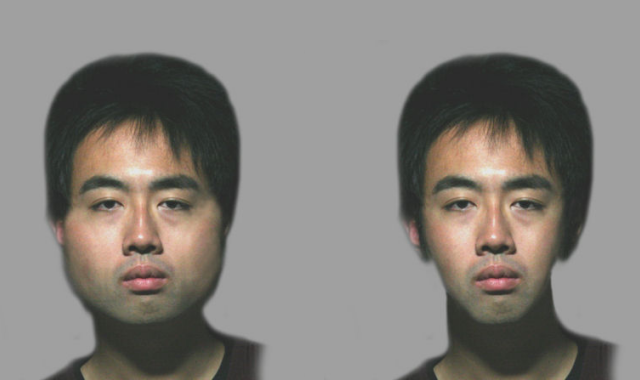
We know from experience that rigid objects can rotate and move but not stretch. A human head is considered to be a rigid object, and therefore is not expected to spontaneously change its shape. This expectation allows us to create the illusion of a head rotating around a vertical axis.

By dividing the 3 dimensional model of a head into left and right hemisphere components, a rotation effect can be achieved by stretching one side while compressing the other along the horizontal dimension via computer algorithms.

The present illusion reveals an interaction between cognitive assumptions about rigidity and visual perception.

Facebooktwittermail
adminRotating by Scaling

The Disappearing Hand Trick

2012 First prize
Roger Newport, Helen Gilpin and Catherine Preston
University of Nottingham, UK

This multi-sensory illusion uses vision, touch and position sense to create the illusion that the hand has disappeared. The felt positions of the hands are gradually adapted without the participant noticing so that the real locations of the hands end up further outwards than their perceived locations. When the right hand is removed from vision and the participant reaches across to touch it, all they can feel is the empty table. The combined loss of vision and touch creates a powerful illusion that the hand is missing and was designed to simulate loss of awareness in stroke patients.

Facebooktwittermail
adminThe Disappearing Hand Trick

When Pretty Faces Turn Ugly: The Flashed Face Distortion Effect

2012 Second prize
Jason Tangen, Sean Murphy and Matthew Thompson
The University of Queensland, Australia

When you stare directly at the faces, they look normal. But, if you stare at the cross, the faces quickly turn ugly.

Like many interesting scientific discoveries, this one was an accident. An undergraduate student was working on face photographs for an unrelated experiment when he was suddenly shocked by the deformed faces staring back at him.

The distortion comes from the many differences between each face and the one that follows. A particularly tanned face, for example, will make the next face seem pale and squinty eyes will make normal eyes bulge.

More info here: mbthompson.com/research

Facebooktwittermail
adminWhen Pretty Faces Turn Ugly: The Flashed Face Distortion Effect

Color Wagon Wheel

2012 Third prize
Arthur Shapiro, William Kistler, and Alex Rose-Henig
American University, USA

Facebooktwittermail
adminColor Wagon Wheel

The colored dot/peripheral vs. central vision

Stuart Anstis
UC San Diego, USA

You will see that the spots move along straight horizontal paths. But now look at it in peripheral vision – look away, but attend to the movie out of the corner of your eye. The paths of the spots now appear to be bent, in the direction of the background stripes. In this example, the spots move around in a circle. But in peripheral vision they appear to slide vertically when the background stripes are vertical, and horizontally when the stripes are horizontal.

Facebooktwittermail
adminThe colored dot/peripheral vs. central vision

Head Size Illusion

Kazunori Morikawa and Eri Ishii
Osaka University, Japan

Which person needs a bigger hat to fit his head? Of course, the fat person appears to have a bigger head than the thin person. This impression is especially pronounced if you look at the face rather than the head. Actually, both persons can wear a hat of exactly the same size because they are identical except the width of cheeks, jaws and necks. Importantly, this illusion is occurring in our daily life! Perception of a body part is influenced by other parts. Makeup, hairstyling, and clothing can take advantage of this kind of illusion to make you look better.

Facebooktwittermail
adminHead Size Illusion

Exorcist Illusion – Twisting Necks

Thomas Papathomas, Tom Grace Sr., Marcel de Heer and Robert Bunkin
Rutgers University, USA

The “Exorcist illusion” is a tricky variation of the hollow-face illusion. We rigidly fused a concave mask and convex torso and vice versa (a challenging sculpting task around the neck). We then painted these rigid “statues” realistically and rotated them. Even though they have no moving parts, they create a compelling paradoxical illusion of twisting necks! The torso rotates in one direction and the face rotates in the opposite direction; thus the neck twists in a strange fashion, similar to the “Exorcist” movie (1973). Also, if a viewer moves in front of the statue, the neck appears to twist dangerously.

Facebooktwittermail
adminExorcist Illusion – Twisting Necks

Illusion of Height Contradiction

Sachiko Tsuruno
Kinki University, Japan

Impossible objects are mental images of solid objects which cannot exist in a real 3D space. So , when looking at them in 3D space, the viewing point must be confined to just one fixed angle and apparent structure of them doesn’t accord with the real structure.
Here, a new unique method is used to make impossible objects . The balls’ motion on the impossible objects of the height contradiction accords with the direction of gravity. The models made from corrugated paper and a polystyrene board in real 3D space. No CGI , no video manipulations except explanation use.

Facebooktwittermail
adminIllusion of Height Contradiction

Silencing awareness of change by background motion

2011 First prize
Jordan Suchow & George Alvarez
Harvard, USA

Play the movie while looking at the small white speck in the center of the ring. At first, the ring is motionless and it’s easy to tell that the dots are changing color. When the ring begins to rotate, the dots suddenly appear to stop changing. But in reality they are changing the entire time. Take a look.

More demonstrations

Facebooktwittermail
adminSilencing awareness of change by background motion

Grouping by Contrast

2011 Second prize
Erica Dixon, Arthur Shapiro & Kai Hamburger
American University, USA, Universität Giessen, Germany
This movie requires Flash Player 9

Luminance levels of four disks modulate in time. The top two disks become white when the bottom two disks become black, and viceversa. When placed against a split background, the disks group together along the diagonals. This grouping pattern follows the contrasts of the disks relative to their backgrounds.

Facebooktwittermail
adminGrouping by Contrast