The break of the curveball

2009 First prize
Arthur Shapiro, Zhong-Lin Lu, Emily Knight, & Robert Ennis

American University, University of Southern California, Dartmouth College, SUNY College of Optometry, USA

In baseball, a curveball creates a physical effect and a perceptual puzzle. The physical effect (the curve) arises because the ball’s rotation leads to a deflection in the ball’s path. The perceptual puzzle arises because the deflection is actually gradual but is often perceived as an abrupt change in direction (the break). Our illusions suggest that the perceived “break” may be caused by the transition from the central visual system to the peripheral visual system. Like a curveball, the spinning disks in the illusions appear to abruptly change direction when an observer switches from foveal to peripheral viewing.

Facebooktwittermail
adminThe break of the curveball

The illusion of sex

2009 Third prize
Richard Russell

Harvard University, USA
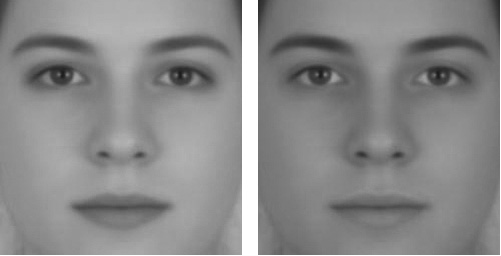
The illusion of sex

In the Illusion of Sex, two faces are perceived as male and female. However, both faces are actually versions of the same androgynous face. One face was created by increasing the contrast of the androgynous face, while the other face was created by decreasing the contrast. The face with more contrast is perceived as female, while the face with less contrast is perceived as male. The Illusion of Sex demonstrates that contrast is an important cue for perceiving the sex of a face, with greater contrast appearing feminine, and lesser contrast appearing masculine.

Russell, R. (2009) A sex difference in facial pigmentation and its exaggeration by cosmetics. Perception, (38)1211-1219.

Facebooktwittermail
adminThe illusion of sex

Stereo vision produces new illusory contours!

Davi Geiger & Hiroshi Ishikawa

New York University and Nagoya City University, Japan
Stereo vision produces new illusory contours!

The perception of the Kanizsa illusory triangle (first row) is strengthened by stereo matching. Does stereo matching use illusory contours as features for matching? Does stereo matching produces new illusory contours?
Stereo vision may not match illusory contours and (new) Illusory contours can be formed after stereo matching occurs (second row).

Facebooktwittermail
adminStereo vision produces new illusory contours!

Tilt illusion

This demo will not work in your current browser. To see this demo, please use a modern browser that supports HTML5 Canvas such as Chrome

Width

Frame Duration ms

What is it? You see (or rather perceive) a tilted line (tilted upwards), even though the dot is moving horizontally in raster scan fashion. If you are not able to see the illusion clearly, set the frame duration equal to reciprocal of your monitor’s refresh rate. Example: if your monitor’s refresh rate is 60Hz, set frame duration = 1/60s = 16ms. You can also try integer multiples of 1/(refresh rate).

Take time to absorb the illusion, and then proceed to explanation page.

Facebooktwittermail
adminTilt illusion

Another turn: a variant on the Shepard tabletop illusion

Lydia Maniatis

American University, USA
Another turn: a variant on the Shepard tabletop illusion

The three pink- and blue-colored parallelograms are the same. All blue lines are equal in length; all pink lines are also equal. Box B is simply Box C rotated counterclockwise.
But the three parallelograms look different, and boxes B and C look different.
Our visual system assumes that the diagonals in A and C are foreshortened and “stretches” them perceptually. The pink lines in B should be foreshortened and stretched, just as they are in C. But our visual system doesn’t stretch a horizontal quite as much as it stretches a diagonal. Why not?

Facebooktwittermail
adminAnother turn: a variant on the Shepard tabletop illusion

Tube illusion

UCD Medical Center, USA;University of Freiburg, Germany;PositScience, USA;University of Sassari, Italy
Tube illusion

Take a cardboard tube, such as from a kitchen paper role, and hold it close to your eye, while keeping the other eye open. Look at a bright wall. The disk-shaped area seen through the tube will appear strikingly brighter than the same surface area viewed by the other eye. The effect is reminiscent of a flashlight illuminating the area under consideration. The effect takes a few seconds to fully develop. It also works with a textured surface where it enhances not only the brightness and color, but also the detail.

Facebooktwittermail
adminTube illusion

Smooth pursuit motion suppression

Peter Tse

Dartmouth University, USA

When you track the little moving dot with your eyes, notice that the expanding/contracting motion in the background appears to be attenuated.
This ‘smooth pursuit motion suppression’ may have evolved to at least partially discount the spurious motion that appears on your retina when you move your eyes.

Facebooktwittermail
adminSmooth pursuit motion suppression

Dramatically Different Percepts between Foveal and Peripheral Vision

Emily Knight, Arthur Shapiro & Zhong-Lin Lu

Bucknell University and University of Southern California, USA
This movie requires Flash Player 9

An object viewed directly (foveal vision) appears noticeably different from the same object viewed indirectly (peripheral vision). To investigate this aspect of how we see, our illusions accentuate the differences between foveal and peripheral perception. In one of these illusions, the “peripheral escalator,” zebra-like columns swing back and forth across the screen. Viewed foveally, the columns appear to move along a horizontal path; viewed peripherally (focus your gaze several inches above the screen), the columns appear to shift back and forth along a diagonal path. The results illustrate that peripheral vision is not just a blurry version of foveal vision.

Read more about the illusion and possible explanations

Facebooktwittermail
adminDramatically Different Percepts between Foveal and Peripheral Vision

Perpetual Collisions

Arthur Shapiro & Emily Knight

Bucknell University, USA
This movie requires Flash Player 9

In the perpetual collisions illusion, the pink and the yellow columns seem always to be headed towards (or away from) each other, but they never meet (and they never grow further apart). Actually, the colored fields are completely stationary; an appearance of motion is generated by the spinning black and white diamonds located alongside the columns. Click on the button to add diagonal bars and remove the edges from opposing diamonds. Notice that the information at the edges makes the colored fields move diagonally, yet when the bars are not there and all the edges are visible, the fields move horizontally.

Read more about the illusion and possible explanations

Facebooktwittermail
adminPerpetual Collisions

Where Has All the Motion Gone?

2007 Third prize
Arthur Shapiro & Emily Knight

Bucknell University, USA
This movie requires Flash Player 9

Click on the big button to toggle between a blurred version of the display and an unblurred version. When the display is blurred, the motion is dramatic; when the display is not blurred, there is only minimal motion. The effect can also be seen with a defocused lens. Blur eliminates high-spatial frequencies. It does not add information to the image. Why, therefore, does the removal of high-spatial frequencies add motion to the display? The buttons and levers allow control over the many of the parameters in the display.

View more demos

Read more about the illusion and possible explanations

Facebooktwittermail
adminWhere Has All the Motion Gone?