The Disappearing Faces Illusion

Stuart Anstis
University of California, San Diego, USA

In the movie the test stimuli were two transparently superimposed, low-contrast greyscale photos. We used one photo of Albert Einstein and one of Marilyn Monroe. Two identical Einstein+Marilyn photos were set up side by side with a fixation point between them; each looked like a confused jumble, and neither face could be seen clearly. The adapting stimuli were high-contrast flickering versions of the two single components: Einstein on the left and Marilyn on the right. Result: Adaptation made Einstein fade out subjectively from the left- hand Einstein+Marilyn, which now looked like Marilyn. Conversely, Marilyn subjectively faded out from the Einstein+Marilyn on the right, which now looked like Einstein. This adaptation selectively picked out (and degraded) the test photo with which it was congruent, and had little effect on the other, superimposed but noncongruent test photo.

Facebooktwittermail
adminThe Disappearing Faces Illusion

Tusi or not Tusi

2013 Second prize
Arthur Shapiro and Alex Rose-Henig
American University, USA

Facebooktwittermail
adminTusi or not Tusi

Through the Eyes of Giants

2013 Third prize
Arash Afraz and Ken Nakayama
Massachusetts Institute of Technology and Harvard University, USA

If a giant whose eyes are 200 yards apart look down at your city, how would the city appear to him? We boarded a Cessna and took areal photographs of Boston from viewing points hundreds of yards apart, then converted the shots to anaglyphs. Using 3D glasses, you can now experience Boston through the eyes of a giant. This way, you perceive the city as a miniature 3D model of Boston; a city that is tiny compared to your head size but has all the details of a real city.

Facebooktwittermail
adminThrough the Eyes of Giants

The Knobby Sphere Illusion

Peter Tse
Dartmouth College, USA

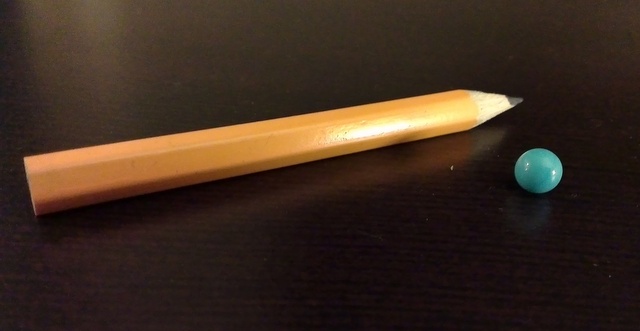
To experience ‘the knobby sphere illusion’ you will need one pencil and a small round hard sphere. Squeeze the pencil lengthwise very hard between your thumb and first finger for 60 seconds, making a deep indentation in the skin. Now feel the ball bearing at the location of the indentation by rolling around in the skin indentation. It no longer feels round, but instead feels like it has rounded corners, as if the ball were in fact sort of hexagonal in cross-section. This is because the brain assumes the receptor sheet is flat, and misattributes the ‘cornerness’ to the ball.

Bottom-line: Deforming the receptor sheet leads to misperceiving the shape of objects.

Facebooktwittermail
adminThe Knobby Sphere Illusion

The Coyote Illusion: Motion Blur Increases Apparent Speed

Alan Ho and Stuart Anstis
Ambrose University College, Canada, and UC San Diego, USA

Cartoonists are known to use multiple illustrative techniques to depict fast moving objects. In the Road Runner and Wile E. Coyote Show, for example, cartoonists drew multiple numbers of feet, usually streaky and blurred inside distorted loops under the cartoon characters’ torsos to symbolize rapid motion. Our illusion demonstrates that the perceived speed of objects can go twice as fast as their actual speed when objects getting blur while that are revolving rapidly in circular paths. This finding supports the view that the human brain uses many strategies to estimate speed of moving objects in the environment.

Facebooktwittermail
adminThe Coyote Illusion: Motion Blur Increases Apparent Speed

Dynamic Size Contrast Illusion

Gideon Caplovitz and Ryan Mruczek
University of Nevada Reno, USA, and Swarthmore College, USA

The size of a moving object can be radically misperceived when the viewer”s eyes are moving and the background against which it is moving is itself changing size. When the background is growing the object will appear to shrink. Conversely, when the background is shrinking the object will appear
to grow.

Facebooktwittermail
adminDynamic Size Contrast Illusion

Rotating by Scaling

Attila Farkas and Alen Hajnal
University of Southern Mississippi, USA
This movie requires Flash Player 9

We know from experience that rigid objects can rotate and move but not stretch. A human head is considered to be a rigid object, and therefore is not expected to spontaneously change its shape. This expectation allows us to create the illusion of a head rotating around a vertical axis.

By dividing the 3 dimensional model of a head into left and right hemisphere components, a rotation effect can be achieved by stretching one side while compressing the other along the horizontal dimension via computer algorithms.

The present illusion reveals an interaction between cognitive assumptions about rigidity and visual perception.

Facebooktwittermail
adminRotating by Scaling

Color Wagon Wheel

2012 Third prize
Arthur Shapiro, William Kistler, and Alex Rose-Henig
American University, USA

Facebooktwittermail
adminColor Wagon Wheel

The colored dot/peripheral vs. central vision

Stuart Anstis
UC San Diego, USA

You will see that the spots move along straight horizontal paths. But now look at it in peripheral vision – look away, but attend to the movie out of the corner of your eye. The paths of the spots now appear to be bent, in the direction of the background stripes. In this example, the spots move around in a circle. But in peripheral vision they appear to slide vertically when the background stripes are vertical, and horizontally when the stripes are horizontal.

Facebooktwittermail
adminThe colored dot/peripheral vs. central vision

Exorcist Illusion – Twisting Necks

Thomas Papathomas, Tom Grace Sr., Marcel de Heer and Robert Bunkin
Rutgers University, USA

The “Exorcist illusion” is a tricky variation of the hollow-face illusion. We rigidly fused a concave mask and convex torso and vice versa (a challenging sculpting task around the neck). We then painted these rigid “statues” realistically and rotated them. Even though they have no moving parts, they create a compelling paradoxical illusion of twisting necks! The torso rotates in one direction and the face rotates in the opposite direction; thus the neck twists in a strange fashion, similar to the “Exorcist” movie (1973). Also, if a viewer moves in front of the statue, the neck appears to twist dangerously.

Facebooktwittermail
adminExorcist Illusion – Twisting Necks