Dancing Diamond

Michael Pickard and Alessandro Soranzo
University of Sunderland and Sheffield Hallam University, United Kingdom


See the illusion

Although the diamonds and patterns in the illusion seem to shift and move about, in reality this is illusory. The diamond edges do not change as their fills are cycled between dark and light where the sense of movement is amplified by changes in lightness and configuration as the ‘whole’ is viewed rather than individual parts. You can explore how different factors interact and affect the illusion of movement by using the controls to change edges, background luminance, size and orientation and see an interesting version of the illusion by pressing the ‘Gestalt-z Waltz’ link.

Facebooktwittermail
adminDancing Diamond

The Disappearing Hand Trick

2012 First prize
Roger Newport, Helen Gilpin and Catherine Preston
University of Nottingham, UK

This multi-sensory illusion uses vision, touch and position sense to create the illusion that the hand has disappeared. The felt positions of the hands are gradually adapted without the participant noticing so that the real locations of the hands end up further outwards than their perceived locations. When the right hand is removed from vision and the participant reaches across to touch it, all they can feel is the empty table. The combined loss of vision and touch creates a powerful illusion that the hand is missing and was designed to simulate loss of awareness in stroke patients.

Facebooktwittermail
adminThe Disappearing Hand Trick

The fat face thin (fft) illusion

Peter Thompson

University of York, UK

It is well-known that faces are more difficult to recognise when they’re upside-down and that sometimes we misperceived the facial expressions of upside-down faces as is shown in ‘The Margaret Thatcher illusion’.
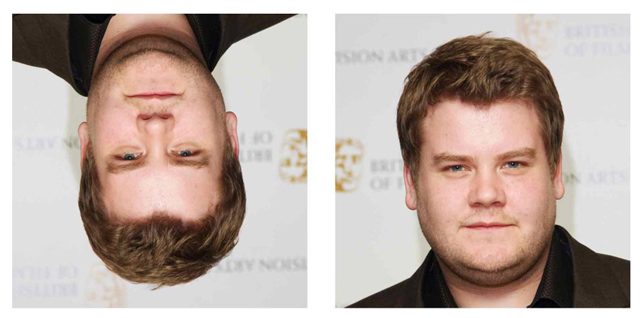
Now I give you ‘The Fat Face Thin illusion’. Compare the upside-down face on the left of the lower figure with the upright face on the right. The upside-down version looks much thinner, – altogether a longer shaped face than the upright version. Of course the pictures are identical. This illusion illustrates the internal features of the face, (eyes, nose, mouth) can distort our perception of face shape.

Facebooktwittermail
adminThe fat face thin (fft) illusion

Jenkins: Ghostly Gaze

2008 Second prize
Rob Jenkins

University of Glasgow, UK
This movie requires Flash Player 9

How do we tell where other people are looking? Conventional wisdom says the dark parts of their eyes give it away. But the Ghostly Gaze illusion reveals a more subtle process.
From a distance, the sisters seem to stare at each other, but as you bring them closer to you with the slider, they turn their eyes to you! This is not a computer trick – to convince yourself set the slider to ‘close’ and walk away from your computer screen while looking at the image: notice that when you are sitting in front of the monitor the sisters are looking at you, but when you are about 3-4 meters away they look at each other!
The illusion is based on the hybrid image technique, developed by Schyns and Oliva. Gaze direction is an extremely important social cue. The Ghostly Gaze illusion shows that details such as the outline of the iris can override larger patches of darkness.

Read more about the illusion and possible explanations

Facebooktwittermail
adminJenkins: Ghostly Gaze

Rolling Eyes on a Hollow Mask

2008 Third prize

Thomas Papathomas

Rutgers University, USA

The well-known hollow-mask illusion: hollow masks appear as normal faces that “follow” viewers who move in front of them. Also, when a hollow mask rotates on a turntable, it appears to turn opposite to the actual direction of the turntable.
An interesting variant: If we add 3-D objects to the mask (e.g., a cigarette) or attach 3-D eyeballs on the whites of the eyes, what will the percept be when we turn the mask? Answer: The result is a compelling illusion in its own right; these objects appear to rotate in the opposite direction to that of the mask.

See a longer version of the video

Read more about the illusion and possible explanations

Facebooktwittermail
adminRolling Eyes on a Hollow Mask

Pinball Wizard

Michael Pickard

Sunderland University, UK


The interesting thing about the Pinball Wizard illusion is that it breaks the ‘rules’. Whilst the classic Rubin Vase illusion demonstrates how we automatically segregate foreground and background in an image, in this illusion a single image is seen acting simultaneously as both, giving rise to an illusory sense of rotation.
Using visual cues to create an impression of depth and carefully chosen colour values, a static screen is combined with an animation of horizontally traversing spheres. The screen appears simultaneously as background and as foreground surface on the spheres – inducing a sense of rotation as the spheres move.

Read more about the illusion and possible explanations

Facebooktwittermail
adminPinball Wizard

Steel Magnolias and Breeze in the Trees Illusions

Michael Pickard

Sunderland University, UK

Breeze in the Trees

Facebooktwittermail
adminSteel Magnolias and Breeze in the Trees Illusions

It’s a Circle, Honest!

David Whitaker

University of Bradford, UK

The illusion in the figure on the left consists of two sinusoidal gratings at 45° and 135° which combine to form a plaid. The contrast of this plaid is windowed by a perfect circle. Despite this, the percept is far from circular – rather, it appears octagonal with distinct sides. The percept is generated by attraction and repulsion of the circular envelope in the orientation domain by the sinusoidal carrier gratings. It relies upon the sharp transition between Fraser illusion (attraction) and Zöllner illusion (repulsion) at the knee-points of the octagon.
Whilst the illusion is scale-invariant in that it does not change with viewing distance, if the scale of the carrier grating is lowered (Figure on the right) relative to the circle, the percept changes from an octagon to a diamond. This is well-predicted by the variation in the strength of the Fraser and Zöllner illusions as the relative spatial scale of carrier and envelope is varied (Skillen et al. (2002) Vision Research 42, 2447-2455).

Facebooktwittermail
adminIt’s a Circle, Honest!

Two-Stroke Apparent Motion

2005 Second prize
George Mather

Sussex University, UK

The illusion contains two pattern frames depicting a moving image (hence two-stroke) which are displayed using a technique that creates an impression of continuous forward movement.

Visit the website

Two-stroke: a new illusion of visual motion based on the time course of neural responses in the human visual system George Mather Vision Research. 2006. 46:2015-8

Facebooktwittermail
adminTwo-Stroke Apparent Motion

The Spinning Disks Illusion

Johannes Zanker

The Royal Holloway, University of London, UK

When sets of disks with tangential greylevel gradients are arranged in concentric circles (see image above, most observers perceive these disks moving around the centre, similar to Kitaoka’s ‘snake illusion’. This motion illusion is enhanced for large-scale and bright images and depends to a large extent to dynamic changes in the stimulus such as elicited by involuntary eye movements or blinks – fixating the centre of the pattern does abolish the illusion, whereas scanning the picture the motion sensation. A reliably effective version of this illusion, which does not require eye movements (i.e. persists when observers fixate the target in the centre of the image), can be generated by modulating the background luminance of the array of disks (see attached animated gif file ‘spin_disks.gif’). This stimulus offers the opportunity of studying this motion illusion – the percept of spinning disks in the absence of any physical displacement – in a highly controlled manner in psychophysical and physiological experiments, because it is not depending on involuntary eye movements or eye blinks. Work in preparation (Zanker 2005) will demonstrate how this illusion can be explained in terms of a two-dimensional motion detector network (2DMD, cf. Zanker & Walker, Naturwissenschaften 91, 149 – 156, 2004).

Facebooktwittermail
adminThe Spinning Disks Illusion