Cubistic lands

This movie requires Flash Player 9

A configuration of alternating dark and light gray shapes positioned in counterphase at the opposite side of a dividing line leads to distinct perceptual outcomes, depending on background luminance. With backgrounds of extreme luminance (black/white), the shapes appear independent and joining at the corner. Backgrounds of intermediate luminance unify the shapes into a surface appearing as “corrugated”, in which illuminance (shadows lines) and reflectance edges are distinguishable. A rotation of the shapes around the orthogonal axis produces either vertical or horizontal furrows on the corrugate surface, depending on which of their sides form, during rotation, the smoothest contour.

Facebooktwittermail
adminCubistic lands

Stereo vision produces new illusory contours!

Davi Geiger & Hiroshi Ishikawa

New York University and Nagoya City University, Japan
Stereo vision produces new illusory contours!

The perception of the Kanizsa illusory triangle (first row) is strengthened by stereo matching. Does stereo matching use illusory contours as features for matching? Does stereo matching produces new illusory contours?
Stereo vision may not match illusory contours and (new) Illusory contours can be formed after stereo matching occurs (second row).

Facebooktwittermail
adminStereo vision produces new illusory contours!

Tilt illusion

This demo will not work in your current browser. To see this demo, please use a modern browser that supports HTML5 Canvas such as Chrome

Width

Frame Duration ms

What is it? You see (or rather perceive) a tilted line (tilted upwards), even though the dot is moving horizontally in raster scan fashion. If you are not able to see the illusion clearly, set the frame duration equal to reciprocal of your monitor’s refresh rate. Example: if your monitor’s refresh rate is 60Hz, set frame duration = 1/60s = 16ms. You can also try integer multiples of 1/(refresh rate).

Take time to absorb the illusion, and then proceed to explanation page.

Facebooktwittermail
adminTilt illusion

Another turn: a variant on the Shepard tabletop illusion

Lydia Maniatis

American University, USA
Another turn: a variant on the Shepard tabletop illusion

The three pink- and blue-colored parallelograms are the same. All blue lines are equal in length; all pink lines are also equal. Box B is simply Box C rotated counterclockwise.
But the three parallelograms look different, and boxes B and C look different.
Our visual system assumes that the diagonals in A and C are foreshortened and “stretches” them perceptually. The pink lines in B should be foreshortened and stretched, just as they are in C. But our visual system doesn’t stretch a horizontal quite as much as it stretches a diagonal. Why not?

Facebooktwittermail
adminAnother turn: a variant on the Shepard tabletop illusion

Tube illusion

UCD Medical Center, USA;University of Freiburg, Germany;PositScience, USA;University of Sassari, Italy
Tube illusion

Take a cardboard tube, such as from a kitchen paper role, and hold it close to your eye, while keeping the other eye open. Look at a bright wall. The disk-shaped area seen through the tube will appear strikingly brighter than the same surface area viewed by the other eye. The effect is reminiscent of a flashlight illuminating the area under consideration. The effect takes a few seconds to fully develop. It also works with a textured surface where it enhances not only the brightness and color, but also the detail.

Facebooktwittermail
adminTube illusion

Smooth pursuit motion suppression

Peter Tse

Dartmouth University, USA

When you track the little moving dot with your eyes, notice that the expanding/contracting motion in the background appears to be attenuated.
This ‘smooth pursuit motion suppression’ may have evolved to at least partially discount the spurious motion that appears on your retina when you move your eyes.

Facebooktwittermail
adminSmooth pursuit motion suppression

Filling in the Afterimage after the Image

2008 First prize
Rob van Lier & Mark Vergeer

Radboud University Nijmegen, The Netherlands

To do:
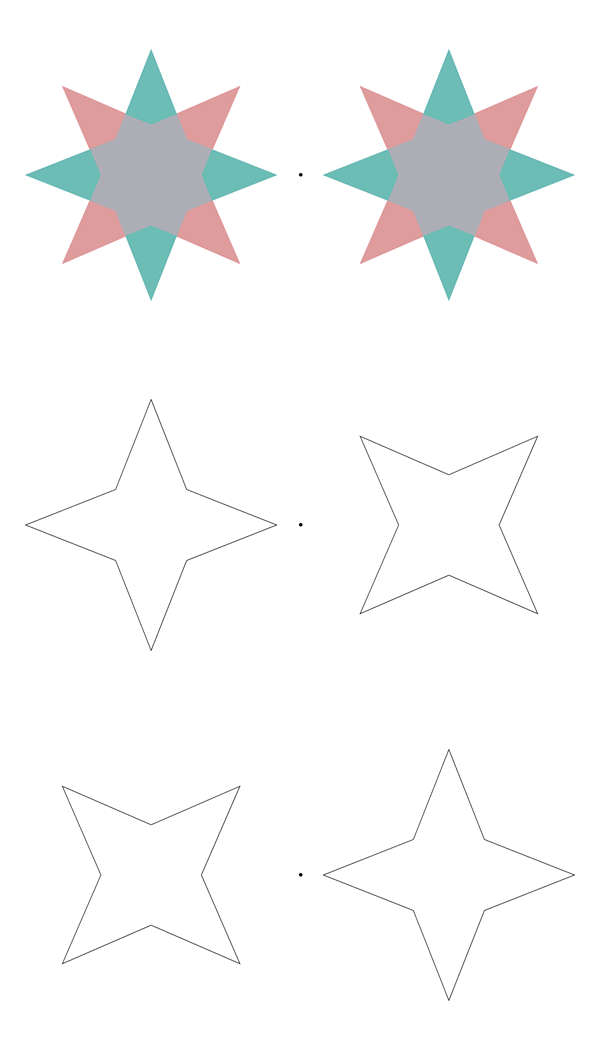
Fixate your gaze on the center of one of the figures and stare at it for some time (20-30 seconds) while it cycles (without moving your eyes). After several iterations you’ll start noticing that the empty outlines fill in with ghostly redish or bluish colors! These illusory colors are called “afterimages”. Interestingly, the colors of the afterimages vary, which is puzzling because they come from the same original figure. Moreover, the shape of the outlines determines the filled-in color, which is complementary to the color of the same shape in the original figure.
What’s happening?
It is well known that viewing a colored surface can induce a vivid afterimage of the complementary color (for example, the color red induces a greenish/bluish afterimage). Our illusion shows that a colored image can produce different colored afterimages at the same retinal location. The perceived afterimage colors depend on the contours that are presented after the colored image. More specifically, the illusion shows that the afterimage colors spread and mix between those contours. In addition, alternating different contours after the original colored image causes rapidly switching afterimage colors.

See more demos.

Read more about the illusion and possible explanations.

Van Lier, Vergeer, Anstis, 2009, Filling-in afterimage colors between the lines, Current Biology, 19 (8), R323-R324.

Facebooktwittermail
adminFilling in the Afterimage after the Image

Jenkins: Ghostly Gaze

2008 Second prize
Rob Jenkins

University of Glasgow, UK
This movie requires Flash Player 9

How do we tell where other people are looking? Conventional wisdom says the dark parts of their eyes give it away. But the Ghostly Gaze illusion reveals a more subtle process.
From a distance, the sisters seem to stare at each other, but as you bring them closer to you with the slider, they turn their eyes to you! This is not a computer trick – to convince yourself set the slider to ‘close’ and walk away from your computer screen while looking at the image: notice that when you are sitting in front of the monitor the sisters are looking at you, but when you are about 3-4 meters away they look at each other!
The illusion is based on the hybrid image technique, developed by Schyns and Oliva. Gaze direction is an extremely important social cue. The Ghostly Gaze illusion shows that details such as the outline of the iris can override larger patches of darkness.

Read more about the illusion and possible explanations

Facebooktwittermail
adminJenkins: Ghostly Gaze

Rolling Eyes on a Hollow Mask

2008 Third prize

Thomas Papathomas

Rutgers University, USA

The well-known hollow-mask illusion: hollow masks appear as normal faces that “follow” viewers who move in front of them. Also, when a hollow mask rotates on a turntable, it appears to turn opposite to the actual direction of the turntable.
An interesting variant: If we add 3-D objects to the mask (e.g., a cigarette) or attach 3-D eyeballs on the whites of the eyes, what will the percept be when we turn the mask? Answer: The result is a compelling illusion in its own right; these objects appear to rotate in the opposite direction to that of the mask.

See a longer version of the video

Read more about the illusion and possible explanations

Facebooktwittermail
adminRolling Eyes on a Hollow Mask

Skyscrapers and Clouds

Sandro Bettella, Clara Casco and Sergio Roncato

Università di Padova, Italy
This movie requires Flash Player 9

Here is a novel illusion that everyone can experience when the jagged contours of skyscrapers appear against the cloudy sky: with the clouds still behind, the skyscrapers contours appear to bulge out and the effect magnifies when the clouds move.
Most illusory distortions of parallel lines disappear if contours are jagged, but not our new illusion: we experience the “Skyscrapers and clouds” illusion because the visual system relies on local luminance contrast to code local tilts and positions along the contour bordered by a thin outline.

Read more about the illusion and possible explanations

Facebooktwittermail
adminSkyscrapers and Clouds