This illusion concerns apparent rotation generated by pure translation. Square patterns consisting of four segments appear to rotate when they move straightly at a constant speed across the grid background. More surprisingly, the rotations in opposite directions can be generated by exactly the same square patterns. This illusion might be explained by well-known inchworm illusion; inchworm illusion arises at the four segments one after another resulting in the impression of rotation. This illusion is new in the sense that the rotation is generated by pure
translation.
Head Size Illusion
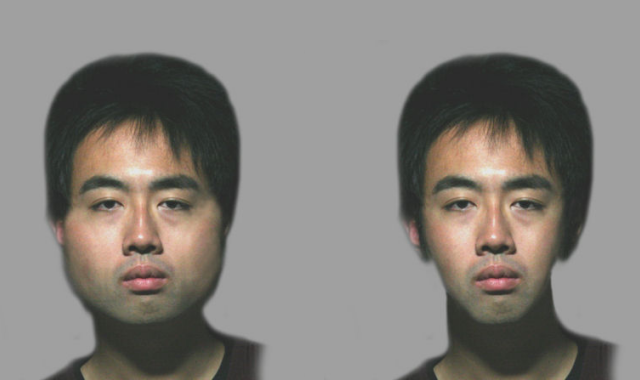
Which person needs a bigger hat to fit his head? Of course, the fat person appears to have a bigger head than the thin person. This impression is especially pronounced if you look at the face rather than the head. Actually, both persons can wear a hat of exactly the same size because they are identical except the width of cheeks, jaws and necks. Importantly, this illusion is occurring in our daily life! Perception of a body part is influenced by other parts. Makeup, hairstyling, and clothing can take advantage of this kind of illusion to make you look better.
Illusion of Height Contradiction
Impossible objects are mental images of solid objects which cannot exist in a real 3D space. So , when looking at them in 3D space, the viewing point must be confined to just one fixed angle and apparent structure of them doesn’t accord with the real structure.
Here, a new unique method is used to make impossible objects . The balls’ motion on the impossible objects of the height contradiction accords with the direction of gravity. The models made from corrugated paper and a polystyrene board in real 3D space. No CGI , no video manipulations except explanation use.
Fishbone Tactile Illusion
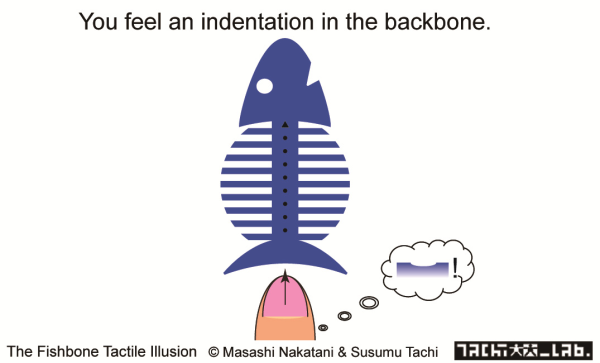
The “Fishbone Tactile Illusion” occurs with a stimulus with the centerline (“fish spine” sandwiched by the ridges (“tiny bones”). You would feel indentation in the centerline, when stroking it with a fingertip, even though it is as flat as the ridges. This illusion occurs because both surface form and texture information are transmitted by the same tactile afferent nerves. Due to the cross talk between those two streams of information, the texture in the ridges can bias the form perception of the centerline. The sample is on my business card, so please come get one and enjoy the illusion!
Impossible motion: magnet-like slopes
In this video, wooden balls roll up the slopes just as if they are pulled by a magnet. The behavior of the balls seems impossible, because it is against the gravity. The video is not a computer graphic, but a real scene. What is actually happening is that the orientations of the slopes are perceived oppositely, and hence the descending motion is misinterpreted as ascending motion. This illusion is remarkable in that it is generated by a three-dimensional solid object and physical motion, instead of a two-dimensional picture.
Stereo vision produces new illusory contours!
The perception of the Kanizsa illusory triangle (first row) is strengthened by stereo matching. Does stereo matching use illusory contours as features for matching? Does stereo matching produces new illusory contours?
Stereo vision may not match illusory contours and (new) Illusory contours can be formed after stereo matching occurs (second row).
Backscroll Illusion
Backscroll illusion is the apparent motion perceived in backgrounds of movie images that present locomotive objects such as people, animals and vehicles. In the attached movie, a human figure presents a walking gait against a counterphase grating. Although the grating has physical motion energies equally in the left and right directions, it appears to drift in a direction opposite to that of the gait.
Backscroll illusion in far peripheral vision Kiyoshi Fujimoto & Akihiro Yagi Journal of Vision. 2007. 7(8):16, 1–7
Backscroll illusion: apparent motion in the background of locomotive objects Kiyoshi Fujimoto & Takao Sato Vision Research. 2006. 46:14-25
ECVP Waves
This stationary image appears to wave without effort. The elemental illusion is our revised version of the peripheral drift illusion, in which the direction of illusory motion is black-to-dark-gray and white-to-light-gray (Kitaoka and Ashida, 2003). In this image, blue and yellow correspond to dark gray and light gray, respectively.