The more-or-less morphing face illusion

Rob van Lier & Arno Koning
Donders Institute, Netherlands

The illusion comprises a morphing sequence between two faces. The observer has to fixate a dot superimposed on the morph. When the dot is moving, morphing can hardly be seen. However, when the dot suddenly stops, the morphing appears surprisingly strong. Subtle differences in, e.g., the shape of the eyes, the color of the skin, and even gender characteristics are “blown-up” perceptually. Apparently, such differences between faces are easily overlooked when following a moving-dot, but are highly salient when our eyes rest at a single point on the morphing faces.

Facebooktwittermail
adminThe more-or-less morphing face illusion

Filling in the Afterimage after the Image

2008 First prize
Rob van Lier & Mark Vergeer

Radboud University Nijmegen, The Netherlands

To do:
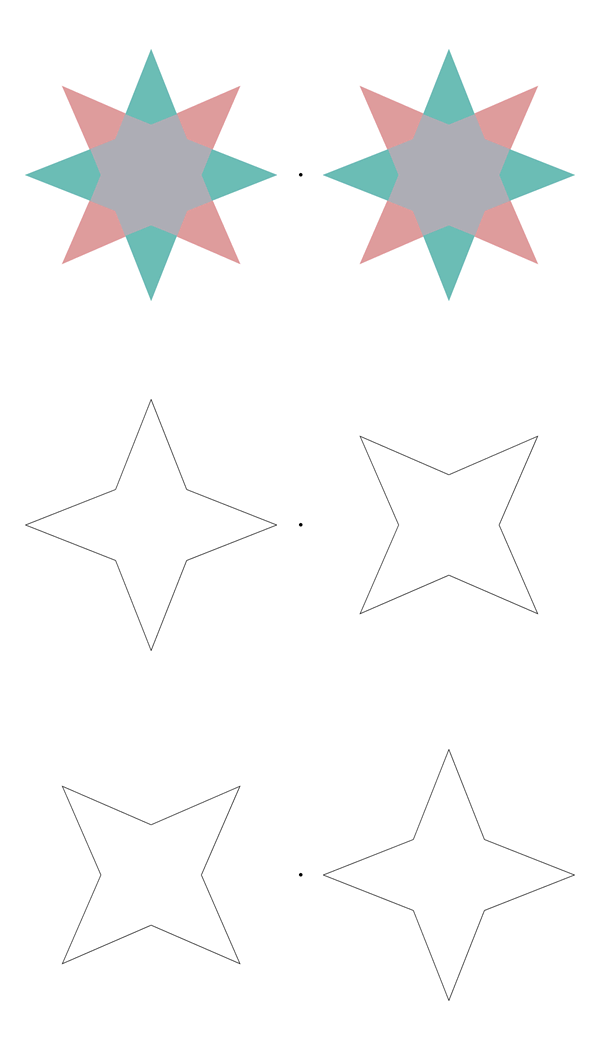
Fixate your gaze on the center of one of the figures and stare at it for some time (20-30 seconds) while it cycles (without moving your eyes). After several iterations you’ll start noticing that the empty outlines fill in with ghostly redish or bluish colors! These illusory colors are called “afterimages”. Interestingly, the colors of the afterimages vary, which is puzzling because they come from the same original figure. Moreover, the shape of the outlines determines the filled-in color, which is complementary to the color of the same shape in the original figure.
What’s happening?
It is well known that viewing a colored surface can induce a vivid afterimage of the complementary color (for example, the color red induces a greenish/bluish afterimage). Our illusion shows that a colored image can produce different colored afterimages at the same retinal location. The perceived afterimage colors depend on the contours that are presented after the colored image. More specifically, the illusion shows that the afterimage colors spread and mix between those contours. In addition, alternating different contours after the original colored image causes rapidly switching afterimage colors.

See more demos.

Read more about the illusion and possible explanations.

Van Lier, Vergeer, Anstis, 2009, Filling-in afterimage colors between the lines, Current Biology, 19 (8), R323-R324.

Facebooktwittermail
adminFilling in the Afterimage after the Image

Catching Patches

Rob Van Lier & Mark Vergeer

Radboud University Nijmegen, The Netherlands
Catching Patches

We present an illusion based on Hermann-grid like gratings in which the contours are quite randomly distorted. These distortions guarantee a severe reduction or complete disappearance of the visibility of the patches. Starting with these gratings we show that the patches at the crossings return when luminance edges are introduced and extended at the intersections. The ‘returned’ patches have the same relative lightness properties as they would have in a regular Herman grid (dark patches when the crossing bands are relatively light, and light patches when the crossing bands are relatively dark). In addition, the polarity of the perceived lightness difference does not depend on the lightness of the edges (i.e., whether they are dark or light). A remarkable effect here is that at the crossings the whole area between the edges is perceived to have a different lightness, irrespective of the shape of that area (i.e., whether the edges bend inward or outward etc.).

See Power Point presentation with different versions of the illusion

Facebooktwittermail
adminCatching Patches