In baseball, a curveball creates a physical effect and a perceptual puzzle. The physical effect (the curve) arises because the ball’s rotation leads to a deflection in the ball’s path. The perceptual puzzle arises because the deflection is actually gradual but is often perceived as an abrupt change in direction (the break). Our illusions suggest that the perceived “break” may be caused by the transition from the central visual system to the peripheral visual system. Like a curveball, the spinning disks in the illusions appear to abruptly change direction when an observer switches from foveal to peripheral viewing.
Color dove illusion
Fix your gaze on the central black point on the bird, as well as while the sky flashes. When the bird starts to fly, follow it, and keep staring at the black fixation point. You’ll start to notice, that the “empty bird” is filled-in with a color similar to the previous background’s color. The colored image produces illusory colors, an afterimage on “empty” shape, which induces an effect opposite to the well known “afterimage” effect. The common “afterimage” effect yields perceived complementary color, whereas the current effect shows an appearance of a color similar to that of the background, where originally, no physical color was present in the empty shape.
The illusion of sex
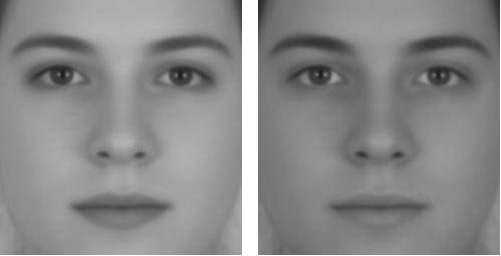
In the Illusion of Sex, two faces are perceived as male and female. However, both faces are actually versions of the same androgynous face. One face was created by increasing the contrast of the androgynous face, while the other face was created by decreasing the contrast. The face with more contrast is perceived as female, while the face with less contrast is perceived as male. The Illusion of Sex demonstrates that contrast is an important cue for perceiving the sex of a face, with greater contrast appearing feminine, and lesser contrast appearing masculine.
Russell, R. (2009) A sex difference in facial pigmentation and its exaggeration by cosmetics. Perception, (38)1211-1219.
Published illusions
|
Illusion: | Dynamic Size Contrast Illusion (Gideon Caplovitz & Ryan Mruczek) |
| Publication: | Dynamic illusory size contrast: A relative-size illusion modulated by stimulus motion and eye movements Ryan E. B. Mruczek, Christopher D. Blair, Gideon P. CaplovitzJournal of Vision 14(3) 2 |
|
Illusion: | The Exchange of Features, Textures and Faces (Arthur Shapiro & Gideon Caplovitz) |
| Publication: | The maintenance and disambiguation of object representations depend upon feature contrast within and between objects Gideon P. Caplovitz, Arthur G. Shapiro, Sarah StroudJournal of Vision 11(14) 1 |
|
Illusion: | The break of the curveball (Arthur Shapiro, Zhong-Lin Lu, Emily Knight, & Robert Ennis) 1st prize winner 2009 Contest |
| Publication: | Transitions between Central and Peripheral Vision Create Spatial/Temporal Distortions: A Hypothesis Concerning the Perceived Break of the Curveball Arthur Shapiro, Zhong-Lin Lu, Chang-Bing Huang, Emily Knight, Robert EnnisPLoS ONE 5(10): e13296 |
|
Illusion: | Dramatically Different Percepts between Foveal and Peripheral Vision (Emily Knight, Arthur Shapiro & Zhong-Lin Lu) |
| Publication: | A First- and Second-Order Motion Energy Analysis of Peripheral Motion Illusions Leads to Further Evidence of “Feature Blur” in Peripheral Vision Arthur G. Shapiro, Emily J. Knight, Zhong-Lin LuPLoS ONE 6(4): e18719 |
|
Illusion: | The blurry heart illusion (Kohske Takahashi, Ryosuke Niimi & Katsumi Watanabe) |
| Publication: | Illusory motion induced by blurred red – blue edges Kohske Takahashi, Ryosuke Niimi, Katsumi WatanabePerception 39(12) 1678 – 1680 |
|
Illusion: | The monkey-business illusion (Dan Simons) |
| Publication: | Monkeying around with the gorillas in our midst: familiarity with an inattentional-blindness task does not improve the detection of unexpected events Simons D Ji-Perception 1(1) 3–6 |
|
Illusion: | The illusion of sex (Richard Russell) 3rd prize winner 2009 Contest |
| Publication: | A sex difference in facial pigmentation and its exaggeration by cosmetics Richard RussellPerception. 2009. 38: 1211-1219. |
|
Illusion: | Filling in the Afterimage after the Image(Rob van Lier & Mark Vergeer) 1sr prize winner 2008 Contest |
| Publication: | Filling-in afterimage colors between the lines Van Lier, Vergeer, AnstisCurrent Biology. 2009. 19 (8), R323-R324. |
|
Illusion: | The Freezing Rotation Illusion (Dürsteler) First prize 2006 Contest |
| Publication: | The Freezing Rotation IllusionMax R. DürstelerProg Brain Res. 2008;171:283-5. |
|
Illusion: | Where Has All the Motion Gone? (Shapiro and Knight) 2007 Third prize |
| Publication: | Spatial and temporal influences on the contrast gaugeArthur Shapiro and Emily KnightVision Res. 2008 Nov;48(26):2642-8. |
| Illusion: | The rotating-Tilted-Lines illusion (Simone & Hamburger) Finalist 2005 Quo Static Illusion Contest | |
| Publication: | A new psychophysical estimation of the receptive field size Arash Yazdanbakhsha & Simone Gori Neuroscience Letters. 2008. doi:10.1016/j.neulet.2008.04.040. |
| Illusion: | The rotating-Tilted-Lines illusion (Simone & Hamburger) Finalist 2005 Quo Static Illusion Contest | |
| Publication: | The riddle of the Rotating-Tilted-Lines illusion Simone Gori & Arash Yazdanbakhsh Perception. 2008. 37:631-5 |
| Illusion: | The Leaning Tower Illusion (Kingdom, Yoonessi & Gheorghiu) 1sr prize winner 2007 Contest | |
| Publication: | Leaning tower illusion Frederick A. A. Kingdom, Ali Yoonessi, Elena Gheorghiu Scholarpedia 2007. 2(12):5392. |
| Illusion: | The Freezing Rotation Illusion (Dürsteler) First prize 2006 Contest | |
| Archive: | The Freezing Rotation IllusionMax R. DürstelerNature Precedings 2007. 371.1 |
| Illusion: | Backscroll Illusion (Fujimoto) Finalist 2005 Contest | |
| Publication: | Backscroll illusion in far peripheral vision Kiyoshi Fujimoto & Akihiro Yagi Journal of Vision. 2007. 7(8):16, 1–7 |
| Illusion: | Kaleidoscopic motion and velocity illusions (van der Helm)Finalist 2007 Contest | |
| Publication: | Kaleidoscopic motion and velocity illusions Peter A. van der Helm Vision Research, 2007. 47:460–465 |
| Illusion: | The Leaning Tower Illusion (Kingdom, Yoonessi & Gheorghiu) 1sr prize winner 2007 Contest | |
| Publication: | The Leaning Tower illusion: a new illusion of perspective Frederick A. A. Kingdom, Ali Yoonessi, Elena Gheorghiu Perception. 2007. 36(3):475-477 |
| Illusion: | Backscroll Illusion (Fujimoto) Finalist 2005 Contest | |
| Publication: | Backscroll illusion: apparent motion in the background of locomotive objects Kiyoshi Fujimoto & Takao Sato Vision Research. 2006. 46:14-25 |
| Illusion: | Two-Stroke Apparent Motion (Mather) 2nd prize winner 2005 Contest | |
| Publication: | Two-stroke: a new illusion of visual motion based on the time course of neural responses in the human visual system George Mather Vision Research. 2006. 46:2015-8 |
| Illusion: | The rotating-Tilted-Lines illusion (Simone & Hamburger) Finalist 2005 Quo Static IllusionContest | |
| Publication: | A new motion illusion: The rotating-Tilted-Lines illusion Simone Gori & Kai Hamburger Perception. 2006. 35:853-7 |
| Illusion: | Con-fusing contours & pieces of glass (van Lier, de Wit & Koning) Finalist 2005 Quo Static Illusion Contest | |
| Publication: | Con-fusing contours & pieces of glass Rob van Lier, Tessa C.J. de Wit & Arno Koning Acta Psychologica. 2006. 123:41-54 |
| Illusion: | The Bar-Cross-Ellipse Illusion (Caplovitz & Tse) 3rd prize winner 2006 Contest | |
| Publication: | The bar – cross – ellipse illusion: Alternating percepts of rigid and nonrigid motion based on contour ownership and trackable feature assignment Gideon P. Caplovitz & Peter U. Tse Perception. 2006. 35:993-7 |
| Illusion: | Gradient-Offset Induced Motion (Hsieh) Finalist 2006 Contest | |
| Publication: | Illusory motion induced by the offset of stationary luminance-defined gradients Po-Jang Hsieh, Gideon P. Caplovitz & Peter U. Tse Vision Research. 2006. 46:970-8 |
| Illusion: | Dynamic Luminance-Gradient Effect (Stubbs) Finalist 2006 Contest | |
| Publication: | A new set of illusionsthe Dynamic Luminance-Gradient Illusion and the Breathing Light Illusion Simone Gori & D. Alan Stubbs Perception. 2006. 35:1573-7 |
| Illusion: | The Infinite Regress Illusion (Tse) 2nd prize winner 2006 Contest | |
| Publication: | The infinite regress illusion reveals faulty integration of local and global motion signals Peter U. Tse & Po-Jang Hsieh Vision Research. 2006. 46:3881-5 |
| Illusion: | The world’s largest lightness illusion (Anderson & Winawer) Finalist 2005 Contest, Winner 2005 Quo Static Illusion Contest | |
| Publication: | Image segmentation and lightness perception Barton L. Anderson & Jonathan Winawer Nature. 2005. 434:79-83 |
| Illusion: | Motion-illusion building blocks (Shapiro & Charles) 1st prize winner 2005 Contest | |
| Publication: | Visual illusions based on single-field contrast asynchronies Arthur G. Shapiro, Justin P. Charles & Mallory Shear-Heyman Journal of Vision. 2005. 5:764-82 |
| Illusion: | Attention-induced brightness changes (Tse) Finalist 2005, Finalist 2005 Quo Static Illusion Contest | |
| Publication: | Voluntary attention modulates the brightness of overlapping transparent surfaces Peter U. Tse Vision Research. 2005. 45:1095-8 |
Sponsors
We welcome sponsorship of the contest from interested parties. Donations will have a lasting impact on vision research and public knowledge of illusion-based research. Please contact Susana Martinez-Conde for details.
| Platinum sponsors ($15.000 and higher) :
Museum of Illusions
|
| Gold sponsors ($5.000 and higher) : |
| Silver sponsors ($500 and higher) : |
| Bronze sponsors (less than $500) : |
Judges
The contest consists of three stages: submission, initial review, gala presentation and election of winners. The initial review is done by a panel of impartial judges, who narrow the submissions down to the Top Ten best entries. The Top Ten finalists present their illusions at the gala celebration. The attendees of the gala vote to choose the First, Second, and Third prize winners.
2024 Judges
John Salmon
Pablo Grassi
Matt Pritchard
Marlene Behrmann
Lesha Porche
Previous judges
2023 Judges
SUNY Downstate Health Sciences University, USA
Lisa Baker
Satoru Suzuki
Frans Verstraten
Michael Cohen
Dawei Ba
2021 Judges
SUNY Downstate Health Sciences University, USA
Shlomit Yuval-Greenberg
Daniel Maarleveld
Michael Cheshire
Mark Mitton
Elias Garcia Pelegrin
2020 Judges
SUNY Downstate Health Sciences University, USA
Ryan Mruczek
Jeanette Andrews
Michael Cheshire
Heather Berlin
Jeff Mulligan
2019 Judges
SUNY Downstate Health Sciences University, USA
Michael Bach
University of Freiburg, Germany
Priscilla Heard
University of the West of England Bristol, UK
Bei Xiao
American University, USA
Amory Danek
Heidelberg University, Germany
2018 Judges
SUNY Downstate Medical Center, USA
Eric Dittelman
Gianni Sarcone
Arthur Shapiro
Laura Thomas
2017 Judges
SUNY Downstate Medical Center, USA
Christine Veras
Peggy Gerardin
Wendy Suzuki
Gideon P Caplovitz
Joseph Dial
2016 Judges
SUNY Downstate Medical Center, USA
Allison Sekuler
Rosa Lafer-Sousa
Patrick Terry
Françoise Pétry
Devin Powell
Alexa Meade
2015 Judges
Barrow Neurological Institute, USA
Thérèse Collins
Université Paris Descartes, France
Ava Do
Red Handed Media Inc., USA
Masashi Nakatani
University of Tokyo, Japan
Kimberly Orsten
Rice University, USA
Virginie van Wassenhove
INSERM, France
Qasim Zaidi
SUNY Optometry, USA
2014 Judges
Barrow Neurological Institute, USA
Arash Afraz
Massachusetts Institute of Technology, USA
Mahzarin Banaji
Harvard University, USA
Jorge Otero-Millan
Johns Hopkins University, USA
Michael Paradiso
Brown University, USA
Maria Victoria Sanchez-Vives
Idibaps, Spain
2013 Judges
Barrow Neurological Institute, USA
Olivia Carter
The University of Melbourne, Australia
Yuhong Jiang
University of Minnesota, USA
Roger Newport
The University of Nottingham, UK
Victoria Skye
Atlanta, GA, USA
Christopher Tyler
Smith-Kettlewell Eye Research Institute, USA
2012 Judges
Barrow Neurological Institute, USA
Anthony Barnhart
Arizona State University, USA
Po-Jang (Brown) Hsieh
Duke-NUS Graduate Medical School, Singapore
Ming Meng
Dartmouth College, USA
Mark Wexler
Université Paris V, France
Jordan W. Suchow
Harvard University, USA
Doris Tsao
Caltech, USA
2011 Judges
Barrow Neurological Institute, USA
Paul Doherty
San Francisco Exploratorium, USA
Alan Gilchrist
Rutgers University, USA
Simone Gori
University of Padova, Italy
Jan Kremlacek
Charles University in Prague, Czech Republic
Xoana G. Troncoso
Caltech, USA
2010 Judges
Barrow Neurological Institute, USA
Yuval Barkan
Tel-Aviv University, Israel
Maria Concetta Morrone
University of Pisa, Italy
Richard Russell
Harvard University, USAMark Setteducati
Magician, New York City
Arthur Shapiro
American University, USA
Lothar Spillmann
University of Freiburg, Germany
2009 Judges
Barrow Neurological Institute, USA
Rob Jenkins
University of Glasgow, UK
Rob van Lier
Radboud University Nijmegen, The Netherlands
Eric Mead
Aspen, CO, USA
Thomas Papathomas
Rutgers University, USA
Michael Pickard
Sunderland University, UK
2008 Judges
Barrow Neurological Institute, USA
Michael Bach
University of Freiburg, Germany
Pietro Guardini
University of Padova, Italy
Frederick Kingdom
McGill University, Canada
Margaret Livingstone
Harvard Medical School, USA
Peter Thompson
University of York , UK
Niko Troje
Queen’s Unversity, Canada
2007 Judges
Barrow Neurological Institute, USA
Gideon Caplovitz
Dartmouth College, USA
Max Dürsteler
Universitätsspital Zürich, Switzerland
Akiyoshi Kitaoka
Ritsumeikan University, Japan
Beau Lotto
University College London, UK
Denis Pelli
New York University, USA
Nava Rubin
New York University, USA
Gianni Sarcone
Archimedes’ Lab TM, Italy
Preeti Verghese
The Smith-Kettlewell Eye Research Institute, USA
2006 Judges
Barrow Neurological Institute, USA
George Mather
Sussex University, UK
Suzanne McKee
The Smith-Kettlewell Eye Research Institute, USA
Dale Purves
Duke University, USA
Arthur Shapiro
Bucknell University, USA
Dejan Todorović
University of Belgrade, Serbia
Jonathan Winawer
Massachusetts Institute of Technology, USA
2005 Judges
Barrow Neurological Institute, USA
Paola Bressan
Universita di Padova Via Venezia, Italy
Richard Brown
San Francisco Exploratorium, USA
Patrick Cavanagh
Harvard University, USA
David Eagleman
University of Texas, Houston Medical School, USA
Marcos Pérez
Casa de Las Ciencias, A Coruña, Spain
Al Seckel
California Institute of Technology, USA
Adrienne Seiffert
Vanderbilt University, USA
Call for Illusion Submissions: The Best Illusion of the Year Contest
Contestants are invited to submit 1-minute YouTube or mp4 videos featuring novel illusions (unpublished or published no earlier than 2023) of all sensory modalities (visual, auditory, etc.) and/or cognitive nature. Novel variants of known illusions are welcome.
The content of the 1-minute video presenting your illusion is solely up to you, and the only requirement is that it wows all viewers! Some examples include, but are not limited to:
- A slide presentation, or succession of images, with a voice over (and/or written text, if you prefer)
- A video of yourself describing your illusion
- A video animation/theatrical performance of your illusion
An international panel of impartial judges will rate all the videos and narrow them down to the Top 10. Then, online voters around the world will choose their favorite illusions from the Top 10 finalists. The Top 3 winners will receive cash prizes: $3,000 USD for first place; $2,000 USD for second place, and $1,000 USD for third place.
The Judge Panel will rate illusions according to:
- Significance to our understanding of the human mind and brain
- Simplicity of the description
- Sheer beauty
- Counterintuitive quality
- Spectacularity
Submissions will be held in strict confidence by the Judge Panel. Only the Top 10 illusions will be posted online, to allow worldwide voting. Participation in the Best Illusion of the YearSM Contest does not preclude you from also presenting or submitting your work for publication elsewhere. By participating in the Best Illusion of the YearSM Contest you agree to have your illusion posted on the Contest website, if selected among the Top 10, and included in press releases and other promotional materials/fundraising initiatives for the Contest. You (and your co-authors, if appropriate) will retain the full copyright of your illusion and receive full credit as illusion creator(s).
Illusions submitted to previous editions of the contest can be re-submitted to the 2024 Contest, as long as they meet the above requirements and were not among the Top 10 finalists in previous years.
You can send your 1-minute video to Susana Martinez-Conde via email (illusion.contest.entries@outlook.com) until September 15th, 2024.
On behalf of the Executive Board of the Neural Correlate Society:
Jose-Manuel Alonso, Stephen Macknik, Susana Martinez-Conde, Luis Martinez, Xoana Troncoso, Peter Tse
2014 Best Illusion of the Year Contest
The Best illusion of the Year Contest is a celebration of the ingenuity and creativity of the world’s premier illusion research community. Contestants from all around the world submitted novel illusions (unpublished, or published no earlier than 2015), and an international panel of judges rated them and narrowed them to the TOP TEN.
Support the contest!
The Contest relies on your donations.
Skyscrapers and Clouds
Here is a novel illusion that everyone can experience when the jagged contours of skyscrapers appear against the cloudy sky: with the clouds still behind, the skyscrapers contours appear to bulge out and the effect magnifies when the clouds move.
Most illusory distortions of parallel lines disappear if contours are jagged, but not our new illusion: we experience the “Skyscrapers and clouds” illusion because the visual system relies on local luminance contrast to code local tilts and positions along the contour bordered by a thin outline.
Read more about the illusion and possible explanations
Dramatically Different Percepts between Foveal and Peripheral Vision
An object viewed directly (foveal vision) appears noticeably different from the same object viewed indirectly (peripheral vision). To investigate this aspect of how we see, our illusions accentuate the differences between foveal and peripheral perception. In one of these illusions, the “peripheral escalator,” zebra-like columns swing back and forth across the screen. Viewed foveally, the columns appear to move along a horizontal path; viewed peripherally (focus your gaze several inches above the screen), the columns appear to shift back and forth along a diagonal path. The results illustrate that peripheral vision is not just a blurry version of foveal vision.
Read more about the illusion and possible explanations