Play the movie while looking at the small white speck in the center of the ring. At first, the ring is motionless and it’s easy to tell that the dots are changing color. When the ring begins to rotate, the dots suddenly appear to stop changing. But in reality they are changing the entire time. Take a look.
Grouping by Contrast
Luminance levels of four disks modulate in time. The top two disks become white when the bottom two disks become black, and viceversa. When placed against a split background, the disks group together along the diagonals. This grouping pattern follows the contrasts of the disks relative to their backgrounds.
Impossible Illusory Triangle

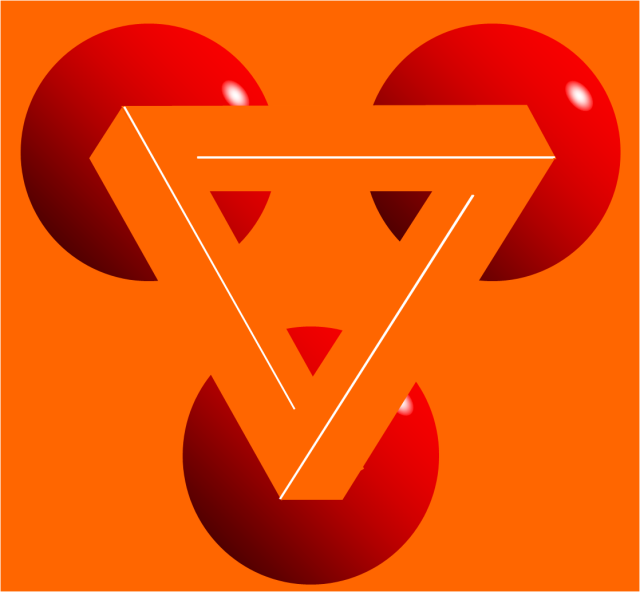
Begin with a three-line figure resembling three chopsticks arranged in a triangle. A wave of a magic wand behind it reveals the structure of a solid triangular object existing only in the way that it dynamically occludes the waving wand. Each part of the object makes sense on its own, but they cannot integrate into a single coherent object because each corner wants to be in front of the other two – a profound 3D spatial intransitivity characteristic of the classic Penrose impossible triangle. The perceived 3D figure generated in this way is simultaneously both illusory and impossible.
Download presentation
Attention-induced motion displacement
Fixate the blue dot.
When you attend to the whole white layer”s motion, the red dots appear to be slanted to the right.
When you attend to the whole black layer”s motion, the red dots appear to be slanted to the left.
When you don”t attend to either layer, the dots are aligned vertically, which they in fact are in every case.
The Exchange of Features, Textures and Faces
The binding problem is a fundamental issue in neuroscience. The term refers to the fact that the brain processes color, motion, and other visual features separately and in parallel, yet our perception is of a unified world, populated by coherent objects. Here we investigate the binding problem with illusions that show—rather dramatically—that features can bind and rebind to moving objects. We show that this effect depends on the color of the background and on whether observers view the illusions centrally or peripherally.
Illusions from rotating rings
A rotating figure 8 made of two overlapping rings is ambiguous. Small spots painted on the rings can resolve the ambiguity, forcing them to look like an 8 or like 2 rings. Even without any spots, if the brightness of the intersections where the rings overlap makes the rings look transparent, they slide. If not, they stick.
Stretching out in the tub
This illusion is based on a billboard showing a bathtub shot at an angle. As we walk from one end of the picture to the other, the bathtub seems to stretch and shrink. Why? Each change in location results in a different retinal image. When processed in the usual way, each of these images results in a different 3D percept. Walking past the real bathtub will also produce a series of retinal images, different from those produced by the picture. All of these images will elicit a single, common 3D interpretation, and thus shape constancy.
The steerable spiral
We show an array of moving spots. Each spot travels in a spiral counterclockwise towards the center of the screen, but contains a grating that moves opposite to its direction of travel. When each spot is by itself its direction of travel is clear. But when we arrange the spots so they are closer together on the screen, they appear to move in different directions — either inward or outward, and either clockwise or counterclockwise, depending on how we arrange them. The proximity of each spot to its neighbors “steers” the perceived direction of motion.
The monkey-business illusion
You might have heard about my earlier demonstration in which people fail to notice a person in a gorilla suit when they are busy counting how many times a group of people pass a basketball (see www.theinvisiblegorilla.com). People can only experience the gorilla effect once-after they know to look for a gorilla, it is no longer unexpected. But what would happen if we tried showing you another video just like it? If you know that something unexpected might happen, and you actively look for unexpected events, does that make you more likely to notice them? Try it for yourself.
Daniel Simons’s presentation of “The Monkey Business Illusion” at the Best Illusion of the Year contest in 2010. He gave the presentation while wearing a gorilla suit.
Attention-biased after-image rivalry
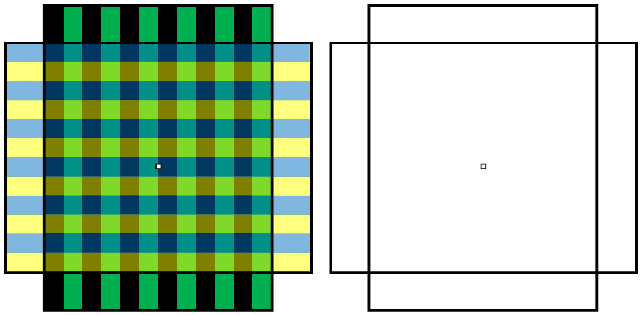
Fixate the colored image by looking at the fixation spot for about 60 seconds. Now shift your eyes to the fixation spot surrounded by rectangular outlines. If you attend to the vertical outline rectangle you will see the afterimage corresponding to it, and if you attend to the horizontal outline rectangle you will see the different afterimage corresponding to it. You can shift which afterimage you experience by attending to one rectangle and then the other.