The Knobby Sphere Illusion

Peter Tse
Dartmouth College, USA
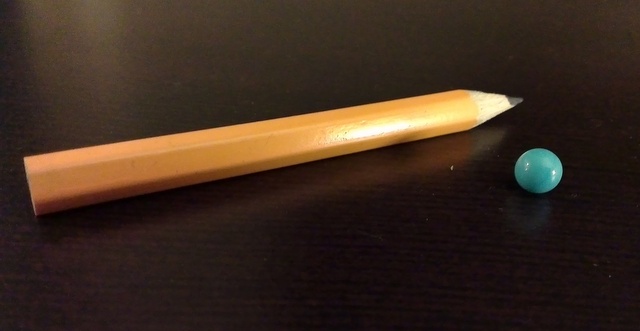
To experience ‘the knobby sphere illusion’ you will need one pencil and a small round hard sphere. Squeeze the pencil lengthwise very hard between your thumb and first finger for 60 seconds, making a deep indentation in the skin. Now feel the ball bearing at the location of the indentation by rolling around in the skin indentation. It no longer feels round, but instead feels like it has rounded corners, as if the ball were in fact sort of hexagonal in cross-section. This is because the brain assumes the receptor sheet is flat, and misattributes the ‘cornerness’ to the ball.

Bottom-line: Deforming the receptor sheet leads to misperceiving the shape of objects.

Facebooktwittermail
adminThe Knobby Sphere Illusion

Attentional modulation of perceived color

Peter Tse
Dartmouth College, USA

Attention can influence the color that you perceive. In the moving case, one disk moves. This brings your attention to it, and you see the whole disk as having a uniform color.However, the middle region in fact always remains gray. This means that you sometimes see a gray region as part of a uniform blue, red, yellow or green object! (If you can”t see the animation you will need to download and install the Shockwave plugin).
This also works when you attend to a single figure in a static drawing. In the case of the static three disks, fixate the central fixation spot and then attend to one disk. The whole disk will appear to take on a uniform color. Attend to a different disk, and it will take on a different color, even though the middle overlap region always remains gray. The same goes for the case of overlapping rectangles. Attend, for example, to the blue rectangle, and the whole rectangle will appear blue. Now, attend to the other rectangle, and the whole rectangle will take on a different hue, even though the overlap region remains gray in every case.

Facebooktwittermail
adminAttentional modulation of perceived color

Attention-induced motion displacement

Peter Tse, Patrick Cavanagh, David Whitney & Stuart Anstis
Dartmouth College, USA, UC San Diego, USA, Université Paris Descartes, France

Fixate the blue dot.
When you attend to the whole white layer”s motion, the red dots appear to be slanted to the right.
When you attend to the whole black layer”s motion, the red dots appear to be slanted to the left.

When you don”t attend to either layer, the dots are aligned vertically, which they in fact are in every case.

Facebooktwittermail
adminAttention-induced motion displacement

Attention-biased after-image rivalry

Peter Tse

Dartmouth College, USA

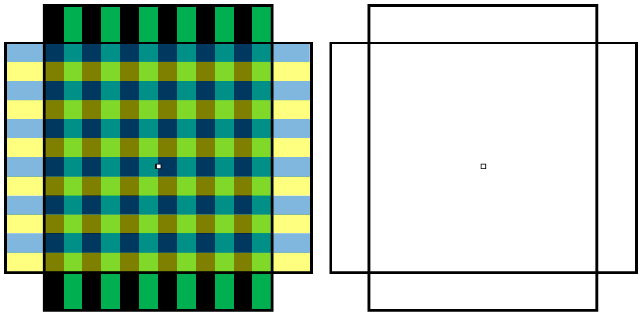
Fixate the colored image by looking at the fixation spot for about 60 seconds. Now shift your eyes to the fixation spot surrounded by rectangular outlines. If you attend to the vertical outline rectangle you will see the afterimage corresponding to it, and if you attend to the horizontal outline rectangle you will see the different afterimage corresponding to it. You can shift which afterimage you experience by attending to one rectangle and then the other.

Facebooktwittermail
adminAttention-biased after-image rivalry

Smooth pursuit motion suppression

Peter Tse

Dartmouth University, USA

When you track the little moving dot with your eyes, notice that the expanding/contracting motion in the background appears to be attenuated.
This ‘smooth pursuit motion suppression’ may have evolved to at least partially discount the spurious motion that appears on your retina when you move your eyes.

Facebooktwittermail
adminSmooth pursuit motion suppression

The Infinite Regress Illusion

2006 Second prize
Dartmouth College, USA


Get the Flash Player to see this content.

Fixate the black fixation point on the far left side of the image. Note that the figure appears to move steadily away from the fixation point, even though it is in fact only moving up and down.


See another version of the illusion

The infinite regress illusion reveals faulty integration of local and global motion signals Peter U. Tse & Po-Jang Hsieh Vision Research. 2006. 46:3881-5

Facebooktwittermail
adminThe Infinite Regress Illusion

The Bar-Cross-Ellipse Illusion

2006 Third prize
Gideon Caplovitz & Peter Tse

Dartmouth College, USA

Here we present a new multistable stimulus generated by continuously rotating an ellipse behind four fixed occluders. Observers can perceive one of four percepts: (1) a continuously morphing cross, (2) two independent perpendicular bars oscillating in depth, (3) a rigidly rotating ellipse observed behind the occluders, or (4) a fixed cross observed through a continuously rotating, elliptical aperture.

The bar – cross – ellipse illusion: Alternating percepts of rigid and nonrigid motion based on contour ownership and trackable feature assignment Gideon P. Caplovitz & Peter U. Tse Perception. 2006. 35:993-7

Facebooktwittermail
adminThe Bar-Cross-Ellipse Illusion

Attention-Induced Brightness Changes

Peter Tse

Dartmouth College, USA

Attention-induced brightness changes occur over bistable transparent surfaces. Fixate any of the points above and shift your attention to one disk or other without moving your eyes. The attended disk appears to change brightness. We believe that this happens because attention biases figure formation such that filling-in happens differently within the attended region than in the unattended region. In particular, the features from the overlap region spread within the boundaries of the attended figure, and not within the boundaries of the unattended region. This happens only for bistable transparent surfaces because only then is it ambiguous over which surface or layer the visual system should carry out the filling-in operation.

Read more about the illusion and possible explanations

Voluntary attention modulates the brightness of overlapping transparent surfaces Peter U. Tse Vision Research. 2005. 45:1095-8

Facebooktwittermail
adminAttention-Induced Brightness Changes